
Review of Chancellor’s November 2025 Budget
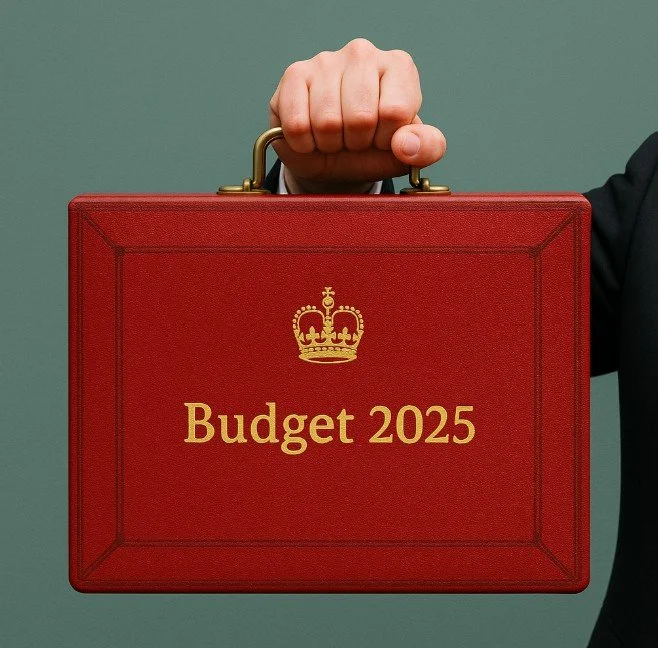
UK November 2025 Budget Review
BUDGET ANALYSIS 2025
The much-heralded Budget 2025 was, unsurprisingly, a tax increasing budget, with the overall tax burden forecast to increase from 36.3% of GDP in 2025-26 to 38.3% in 2030-31. Although it is no surprise that the Chancellor ‘came back for more’, it is the reason why she raised an additional £26 bn that raises eyebrows. It was not to plug an anticipated huge fiscal hole, rather it was to increase the county’s fiscal headroom and political stability. This will hopefully make the country’s finances less volatile over the next few years to help businesses plan with confidence, recruit and grow for future generations.
The budget was not a reforming one with few measures which will help The Government’s growth agenda. Unfortunately, the budget seemed to be one for ‘stability’ rather than a bold agenda for innovation and growth.
What we liked:
Labour Market
£820m of funding to guarantee paid work placements for 18 to 21-year-olds to tackle the youth NEET (Not in Employment, Education or Training) problem. The funding will pay for three years of the Youth Guarantee scheme offering young people in England an apprenticeship, training, education, or help to find a job.
Training costs for apprentices under 25 to be fully funded for SMEs from 2026
An additional 350 planners to support planning reform, and a Planning Careers Hub is also welcome to retain and retrain more planners in the profession. Lack of planning capacity is a key sticking point currently.
Infrastructure/Capital spending:
Allocation of just under £900 million to complete the publicly funded works for the Lower Thames Crossing; boosting capital investment in the NHS by £300 million; establishing the Leeds City Fund as a 25-year Business Rates Retention Zone, additional funding to support the development of EV infrastructure (plus business rates relief for EV only forecourts).
As a global company proud of our North-eastern roots, we are pleased that the Chancellor announced £16m for a new STEM centre in Darlington which is also attracting £5m from the Government's 'Pride in Place' fund.
Industrial Sectors and Business Measures
Announcement of plans to permanently reduce business rates for retail, hospitality and leisure properties coming out of Covid relief plus the establishment of a transition fund.
Introduction of a three-year stamp duty holiday on the purchase of shares in companies listing in the UK – a welcome move to increase investment.
Anticipation of The Government acting on some of the report from the Nuclear Regulatory Taskforce regarding simplifying and deregulating the commissioning and building of new nuclear power reactors, the UK having the highest costs in the world. The country’s first small modular reactors (SMRs) are to be built in-country with Rolls-Royce
The government’s plans involve a focus on AI and automation support – with two AI Growth Zones worth £10 million being promised to Wales on the heels of investment in other areas of the UK, including the North-east.
An extension of AI adoption support to the Industrial Strategy's high-growth sectors
Other Macro and Specific Measures
The Chancellor being brave enough to increase her fiscal headroom to reduce future volatility.
The Chancellor came up to the mark in addressing the issue of taxing electric vehicles, through her per-mile flat tax.
A change to ISA rules to drive more individuals to invest rather than save with the £20,000 per annum ISA limit retained but a cap on savings ISAs of 12,000 and £8,000 to go into stocks and shares ISA
What we didn’t like:
The freezing of income tax thresholds is regressive and also runs the risk of reducing consumer spending.
Higher business tax rate for the largest business properties (those with a rateable value of £500,000 and above) which will be used to fund permanent business rate reductions for smaller retail, hospitality, and leisure (RHL) premises. While the additional levy could be a good way of extracting more tax from multinational online retailers through their warehouses, it will also affect domestic retailers and other businesses with larger premises.
Lack of wholesale reform of the tax system which is overcomplicated.
Lack of ambition and bold growth narrative